
-
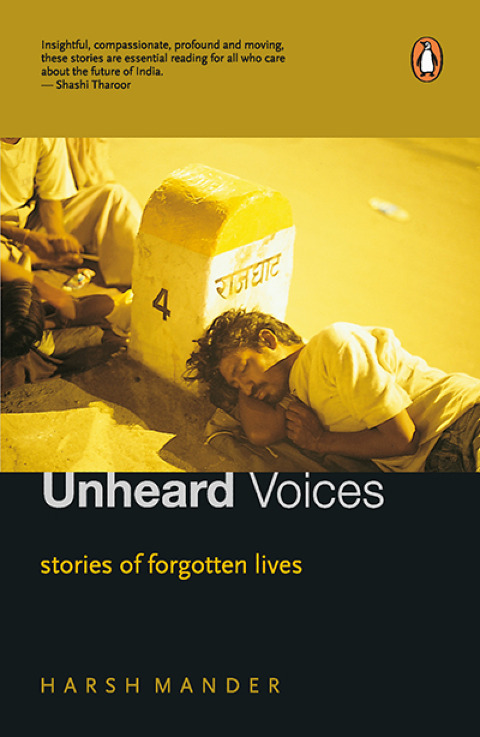
Unheard Voices Stories Of Forgotten Lives
The Bhopal gas tragedy, the communal carnage of 1984 and 1989 in Delhi and Bhagalpur, the Orissa super cyclone, among others, are part of collective memory, But, often forgotten are those who actually were affected by thee happenings, and others like them, street children, sex workers, dalits, HIV and leprosy patients, the homeless and the famine-stricken. These are people who in many ways are pushed to the outermost, most hopeless margins of society in the name of development and progress. In Unheard Voices, civil servant and social activist Harsh Mander draws on his own and his colleagues’ experiences to explore the lives of twenty such people who have survived and coped despite all odds. In Bangalore, for instance, a onetime street child now counsels other such children seeking education and self-employment; in Bhopal, and eleven year-old has brought up two of his siblings after they were orphaned in the gas leak, at great emotional cost. A young sex worker fights for the rights of her HIV positive sister-workers when their ‘home’ in Hyderabad’s red-light area is demolished. A patient combats the stigma of leprosy by helping to establish a leprosy colony in Ashagram. In Tenali, Andhra Pradesh, a blind musician couple struggles to get land from the government to set up a colony for the blind. Going beyond mere survival, these stories are a testimony of how people have overcome their condition with humbling courage, resilience, and humanism, Marked by understatement and rare warmth, they bring out their determination to seek a better life in the face of enormous suffering. Reaffirming people’s creativity and indomitable spirit, this book challenges all those who despair about India.
-
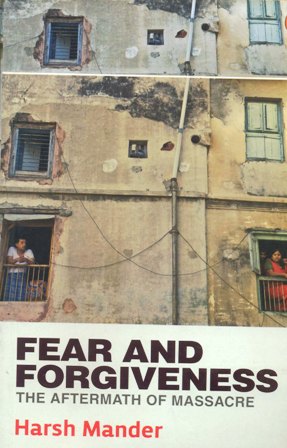
Fear and Forgiveness: The Aftermath of Massacre
Human history is not just a history of cruelty, but also of compassion, sacrifice, courage, [and] kindness. What we choose to emphasise in this complex history will define our lives..."-Howard Zinn In February 2002, a violent storm of engineered sectarian hatred broke out and raged for many months in Gujarat; blood flowed freely on the streets and tens of thousands of homes were razed to the ground. An estimated 2000 men, women and children, mostly from the Muslim community, were raped and murdered, and more than two hundred thousand people fled in terror as their homes and livelihoods were systematically destroyed. However, Gujarat abounds with thousands of untold stories of faith and courage that endured amidst the fear and hate—Dhuraji and Babuben Thakur who sheltered 110 Muslims for ten days in their home; of Rambhai Adivasi who restored his Muslim neighbour's roof in the face of local opposition, Rabiya of Ratanpur who waits in the hope that the people from her village will call her back one day and then everything will be all right, Bilkis Bano and Niyaz Bibi whose perseverance and determination have made them symbols of courage in the face of adversity. Harsh Mander's Fear and Forgiveness: The Aftermath of Massacre, written over the past six years, is not just about the grim events of 2002, of the state's lack of accountability and the failure of justice, of the numerous commissions and their reports, of the indiscriminate use of the draconian Prevention of Terrorism Act 2002, of police brutality and the trauma of relief camps. It is about the acts of compassion and courage, of the hundreds who risked their own lives and those of their families and their homes to save innocent men, women and children, and even today help the betrayed and shattered minority heal and rebuild. The book compels us to acknowledge the flaws in our judicial, social and rehabilitative structures while showing that the way forward must be one of sympathy, understanding and forgiveness.